Showing posts with label my two cents. Show all posts

Monday, December 15, 2014

A Thought about Composers and Artists

Tell me why, when I listen to the conversation of young artists, painters, or sculptors, I can follow their thoughts and understand their opinions and aims, and I seldom hear them mention technique, save in certain cases of absolute necessity?  On the other hand, when If ind myself among musicians I rarely hear them utter a living idea; one would think they were still at school; they know nothing of anything but technique and 'shop-talk.'  Is the art of music so young that it has to be studied in this puerile way?

-- Modest Mussorgsky

A man, in our times, if only he possesses such a talent and selects some specialty, may, after learning the methods of counterfeiting used in his branch of art, if he has patience and if his aesthetic feeling... be atrophied, unceasingly, till the end of his life, turn out works which will pass for art in our society. To produce such counterfeits, definite rules or recipes exist in each branch of art. So that the talented man, having assimilated them, may produce such works a froid, cold drawn, without any feeling.

...

"It is impossible for us, with our culture, to return to a primitive state," say the artists of our time. "It is impossible for us now to write such stories as that of Joseph or the Odyssey, to produce such statues as the Venus of Milo, or to compose such music as the folk-songs." 
 And indeed, for the artists of our society and day, it is impossible, but not for the future artist, who will be free from, all the perversion of technical improvements hiding the absence of subject-matter, and who, not being a professional artist and receiving no payment for his activity, will only produce art when he feels impelled to do so by an irresistible inner impulse.

--Leo Tolstoy

Sunday, March 2, 2014

Getting Integrated (or, The Main Reason Why I Am Still Single)

They say that when you marry someone, you're also marrying his/her family.

I fought this saying for a long time.  I always thought that if you loved each other enough, there should be nothing -- not rain, not snow, not your future mother-in-law -- that could stop you from being together.  Yeah, family reunions may be a little unpleasant, but they don't last forever and you hardly ever have to interact with your spouse's family outside of that, so what's the big deal?

But after watching several of my dear friends tie the knot, I have come to understand how true such an adage is.  Couples' families have a huge influence over the couple.  Families-in-law will forever be a driving force in your joint decision-making as a married unit.  Odds are you'll see them far more often than just during weddings and funerals.  And your potential spouse will surely hold his or her family as a high priority and hope that you will get along with them.  I know I feel that way; I usually don't let a guy get to relationship status without getting the go-ahead from my sister, first.

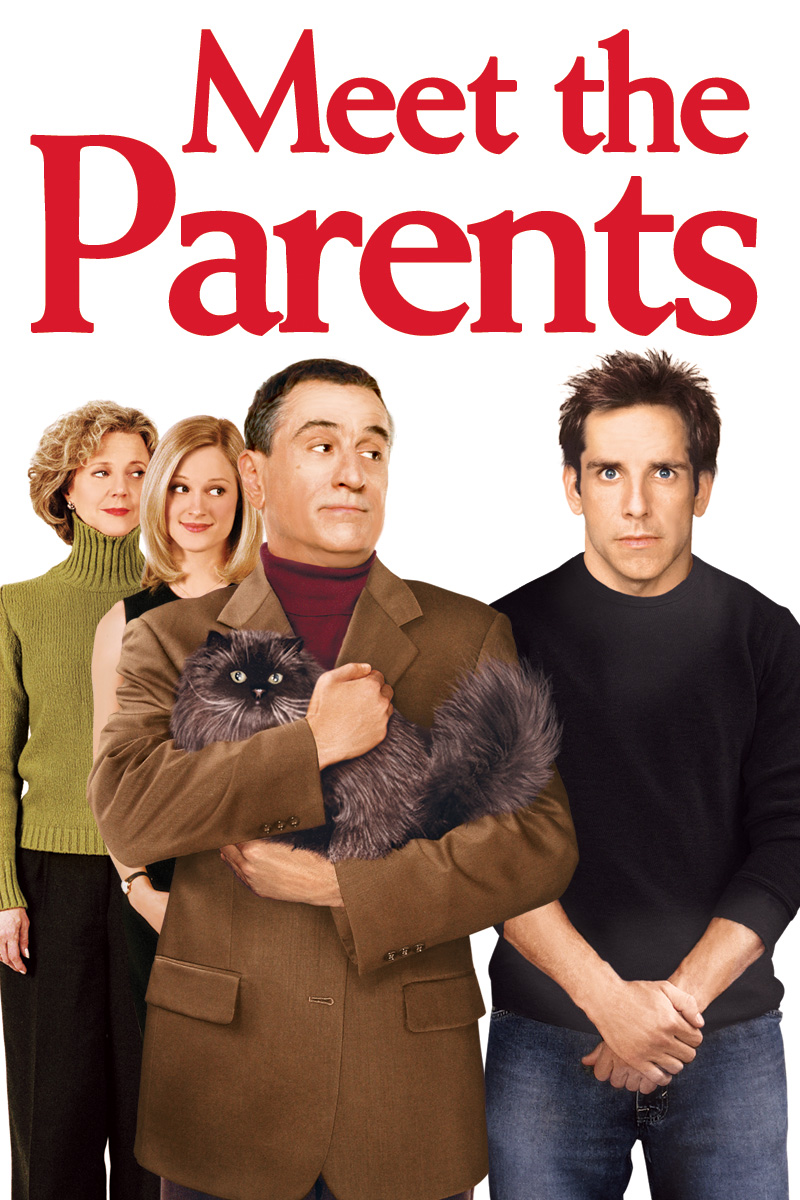
A lot of us have a "meet-the-parents" story of one kind or another.  I, myself, haven't had many experiences with a boyfriend's parents, but the ones I have had... Well, they haven't been great.  And in all these instances, my relationship with the man's family foreshadowed the ultimate fate of the relationship I had with the man.   My first 'official' boyfriend had a mother who thought that I was some temptress who had come to kidnap her son and whisk him away into a Gaga-loving Babylon.  The second time I 'met the parents,' was a similar story.  (It's funny.  When you meet a guy's parents, you suddenly realize exactly why he has the quirks that he has.  But I can discuss that at a later date.)

It's always going to be awkward.  Always.


And the one and only time I introduced a boy to my mom and dad?  I shudder at the memory.

Yes, family is important.  But there's another important group of people you need to consider when discussing a long-term relationship, and that is the very loosely-defined group of people known as "the friends."

You know what I mean when I say "friends." Those people you -- as a college student living away from home -- spend the most time with.  As a girl, you may have your girlfriends, just as a guy may have his bros. They often are your roommates or coworkers.  Perhaps they're people who share your major and who share similar class schedules and interests.  Sometimes it's a ward group.  Or, if you're lucky, they can be this group of friends you've known since you were kids.  People who grew up with you.  People you would expect to see cheering you on at your wedding.  After all, you were there for theirs.

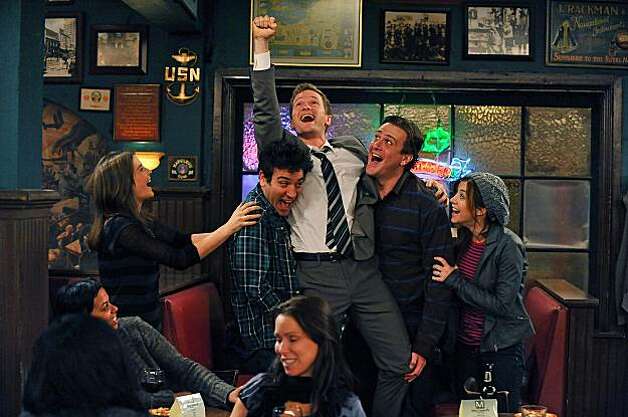
When I think of a close group of friends, I first think of the five protagonists from the hit TV series How I Met Your Mother.  Ted, Marshall, Lily, Robin, and Barney.  Always doing things together.  Dating each other.  Meeting at the same bar year after year.  They know everything about each other, share common experiences, and are there for each other when things go wrong. While it does seem a little contrived, most of us can relate to this kind of thing.  Lots of us have a "best friend" like Marshall.  Many of us have a "pet married couple" like Marshall and Lily, who may act as our surrogate parents from time to time while we're away from home.  And, let's face it, most friend groups have a Barney Stinson -- the one whack-job in the group who seems like he wouldn't fit, but somehow does.  Although our circumstances change, time and experience have helped us understand that true friendships transcend petty differences and difficult conflicts.

Ted, Marshall, Lily, Robin, and Barney... They know everything about each other, share common experiences, and are there for each other when things go wrong. 

If I were to meet Ted at the supermarket (or at a wedding, or while trying to remove a tattoo, or perhaps as I was protesting against one of his architectural endeavors...), I would feel more fear in meeting his four closest friends than in meeting his mother or his father.  In some ways, it is more challenging to inundate yourself into another's group of friends than it is to inundate yourself into a person's family.  Sure, family's where you come from and where you always find yourself going back.  But friends?  That's where you choose to spend all the rest of your time.  These are the people you WANT to be with, not just the people you're born with.  These are the people you share interests with, the people you purposely develop deeper relations with, people you learn from.  While you're out in college, your friends become your second family.

And, unlike a person's real family, the friends are there from the beginning.  Rarely do we ever think of introducing a guy or girl to our parents on the first date.  Even if I wanted them to meet, it's pretty difficult to ever introduce a guy to mom and dad, since they live so far away.  I've hardly been in a relationship for enough time for that to even be an issue.  In the meantime, though, most people have this "second family" that they grow super close to, and you meet them right away.  You may not have to schmooze mom and dad immediately, but you may need to get past the BFFs on the very first date.

Often, you are faced with the super important ritual known as meeting the roommates.  Not only does it give a person the chance to see how a date responds to meeting these new people, but it also can be very revealing to hear what the roommates think of the guy you just brought home.  Do they like him?  Do they seem to get along?  I can't tell you how many times I've closed the door after a date, only to immediately turn to my roommates and say, "Well, what do you think?  Thumbs up or thumbs down?"  Their poor opinion may not be the dealbreaker, but it could definitely weaken your relationship.

Meeting the roommates:  Their poor opinion may not be the dealbreaker, but it could definitely weaken your relationship.
And even if you pass the initial go-ahead, you're then faced with the next step: initiation. Now this step can be bypassed if your new friend already is a part of your social group. It's nice to date someone who has already spent plenty of time with your friends and he's already comfortable with you as part of a group of other close compatriots. It's convenient when that happens. The transition from 'friend' to 'boyfriend' is a lot more calm when he's already a part of your life and your friend group.

But what if you met the guy online, or on the street, or at the gym?  You have almost nothing in common with him, socially speaking.  You come from separate worlds.  He rock-climbs and hikes, you make music and see plays.  If the personalities aren't right, these separate worlds could collide in a catastrophic explosion.  Or it could at least lead to a super awkward experience, and early on, such awkward experiences can break down the relationship completely.  You don't want your relationship to begin on too wrong of a note, or else it will end before it starts!

How hard is it to meet the Best Friend?  Boyfriend may be super excited to introduce you to him, but don't you still feel the need to dress just a little nicer and act just a little cooler?  After all, this is your boyfriend's Best Friend.  Anyone who's best friends with your dream guy oughta be super cool and super important, right?  His opinion must be super important, right?  And what if BestFriend doesn't give you the seal of approval?  Depending on how much time Boyfriend spends with BestFriend, you may be in for a rough time.

And it's even worse when there's a group of Best Friends, like in How I Met Your Mother.  When you meet a new group of people, seldom is someone going to bother filling you in on the inside jokes that they all share, their past experiences, or the traditions they hold. You are the random stranger, surrounded by people you don't know, and you have to share the attention of the one person you have any attachment to with all of these other folks. And perhaps your mere presence puts a damper on things for them? Perhaps you are the rain on the parade that is BestFriend tradition.   You show up on the hiking trip, you appear in all the mission reunion photos, you tag along to the movies... Cool as you are, you can't change the fact that you're someone new.  Different.  You're the stranger.  The buzzkill.  The newbie.  Yuck.

When you meet a new group of people, seldom is someone going to bother filling you in on the inside okes that they all share, their past experiences, or the traditions they hold. 
Even when you do things alone, there's still pressure to have a mutual friend group to talk about.  It's hard to talk about a funny thing that happened at work when your beau has never met your coworkers.  It's hard for him to talk about his band when you've never met his bandmates.  We are social animals.  We thrive in environments where we can make connections and form further relationships.  You can only spend so much time on formal, one-on-one dates.  If you ever want to marry someone, you need to meld your entire life with someone else's entire life.  This stranger to your world needs to become an established regular.  An integrated part of your social life.  Getting to that point is very challenging.

In my own situation, I find that this whole issue concerning social integration is the primary factor that has come between me and a successful relationship.  You can trace most of my problems back to the fact that I have very few close friends. I consider myself an unestablished socialite.  My personality does not cater to having a posse or a clique or a cohort that I always do things with. I spread myself thin; I have lots of friends, but few of them are really close. There's no automatic list of people I would call to go get Denny's with on a weekend.  My friendships are more the kind where I can easily say "hi" to someone I recognize if our paths happen to cross.  I get invited to things on occasion, and while I am an extrovert who can adapt to these kinds of situations pretty easily, I do recognize that I am different and I don't immediately click with lots of people.  In such an in-transit environment as a college campus, getting to know a group of people well enough to have them be a major part of my life is hard for a girl like me.  One-on-one, I'm great.  Get me with a group, and I detach myself.  So rather than having this group of people that I always do things with, I have a smattering of individual friendships that I do one-on-one activities with on occasion.  I don't dislike this lifestyle.  It makes for an awesome formal dating experience.  One-on-one planned activities with the purpose of getting to know someone better?  I shine in that environment.  It's just that next step that I have trouble with.

So that's the first thing going against me: My social temperament. But let's not assume that I am incapable of surpassing my normal disposition and creating close bonds with groups of people.  I have had 'cliques' in the past.  My old roommates were one, and my former coworkers were another.  But then my roommates moved out and I quit my job... And now I live in the basement of my grandparents' house.  I live in a scattered ward, working as a junior high school teacher and personal research assistant to a professor.  The only people I come in contact with these days are my pre-teen students, my married mentor teacher, my grandma, and my professors.  So much for having a common social circle with my potential eternal companion! Heck, it's hard enough to find guys to simply go on dates with, let alone find a relationship.  And when someone special does show up in my ward or wherever, he's usually so well established in some other social group, and a hermit like me can hardly get her foot in the door.

Let's not assume that I'm incapable of surpassing my normal disposition... I have had cliques in the past.  My old roommates were one.
I am willing to share that I, myself, have been hit with the words, "I just don't think you'd get along with my friends, Hannah.  And that's really important to me.  Sorry. We're through."  But I don't think a guy needs to actually say that in order for me to feel the social pressure of having to win the hearts of not only the guys I'm interested in, but also of their friends.  Yes, it's a frustrating thing, knowing that most of the men I interact with have totally separate lives from me and, thus, the cards are stacked against me.

I guess that's why I'm still single.  I haven't figured out this whole "meet-the-friends" thing yet.

 But I'm discovering the solution...

All this being said, here are some things you need to be successful in dating.  Mind you, this is not a comprehensive list, but it may contain a few things that you may not initially think of, or it may put a new spin on some of the common things you hear as a single adult all the time.

1.  Do stuff.  Get out there and find a hobby that you can share with others.  Climb rocks, make music, join an opera, play tennis, go to institute, take a dance class, join a dinner group, start a game night, go to Home Evening, attend the extra seminars...  Be social.  You've probably heard this advice before, and you're always given the same reason for it:  You can't meet your future companion if you never put yourself in a position to meet someone.  And yeah, that's a valid argument.  But there's more.  I also think it's important for people to have a social group.  They don't need to be your eventual bridesmaids or the godparents for your future children, but it's healthy to have a group of people that you have things in common with.  You'll improve your social skills, you have a non-family support group, and -- of course -- you'll have fun.  Yes, you can have fun when you're single.  Fun exists outside of marriage.
2.  Group date.  If you're a nonestablished socialite like me, group dating provides a social outlet that you don't achieve in other group settings.  Double dates are nice; they're still small enough to be intimate.  They give you a chance to see how your date operates in a group, and your date can see how you operate in a group.  And suddenly you've created a mutual friend base that both of you have in common.  Total win.

Group dating provides a social outlet that you don't achieve in other group settings.
3.  Hopefully this essay will help you realize that meeting the friends can be an awkward thing for your date.  There are ways to make it easier.  Don't put a ton of pressure on it.  Bring your new friend into the group.  Make some formal introductions, and then continue to make informal introductions.  It's so nice to have a date who is willing to go the extra mile to make me feel comfortable with his friends.  And it's very encouraging when I end up making a few new friends in the whole dating process.
4.  Remember:  Life is about forming positive relationships with lots of different people.  It's not all about just finding that ONE person you're going to spend the rest of your life with.  If and when you do find that special someone, it doesn't mean you can completely forget about the other relationships that helped you get to that point.  Yes, marriage is a priority, but brotherly love, service to those around you, and learning from others is also an important part in this life journey.
Furthermore, if you never get out there and start forming good friendships, you'll never get the chance to meet the notorious "friend-of-a-friend."  I met my last boyfriend at a mutual friend's music show at a club.  I had no intention of meeting a companion when I went, but we were introduced and things moved quickly forward from there.  I never would have met him, had I not been a supportive friend already.  The more people you know, the more you're able to network.  That can help your romantic life as well as your career.
5.  Find out about yourself, what you want, and what your goals are.  I never could have written this a year ago.  That was before I realized what kind of a person I was in groups, how I interacted with people one-on-one, and what my interests were in a future companion.  Since then, I have discovered that I'm an extrovert with interesting hobbies and a bold, colorful personality that caters well to certain other personalities.  The moment I figured stuff like this out, I suddenly became more confident with other people, and I started picking guys that were better for me within social groups where I was already comfortable.  Since I am a musician, I take advantage of interactions I have with other musicians.  I make the conscious choice to expand upon my relationships with women and men who are interested in post-graduate education, like myself.  In a spiritual sense, I am better able to "separate the wheat from the tares" in dating when I am truly confident in my end goal: to marry for eternity in the Lord's Holy Temple.  When you know who you are and what your true desires are, you more quickly find those things you desire.  Remember your goals.  Remember who you are.

Remember your goals.  Remember who you are.
6.  Speaking of picking, it's totally okay to consider the friends as you're making decisions about a relationship.  I do not look down on the guy who rejects me because of how I get along with his friends.  Your friends are important, just like family is important.  It's good to give people a chance, but if you know that integrating a certain kind of person will cause excessive conflict and stress on you and your social group, maybe it's a good idea to search for your companion elsewhere. This is especially true when it comes to spiritual things.  If your date's buddies don't keep the same standards that you do, there is a perfectly legitimate reason to hit pause and re-evaluate.  Everyone is different, and there will usually be conflict of some kind, but there is a line.  Find it, and don't cross it.
7.  If you don't have a How-I-Met-Your-Mother group, don't try to get one.  You can't force a friend group like that, and they are not necessary for finding happiness in your social life.  They emerge on their own, if you are patient and if you are genuine and trustworthy.  I found that the moment I stopped trying to form a posse, people felt a lot more comfortable around me and little groups began to form by themselves.  And if I never end up having a tight-knit group like that, it's fine.  I'll settle for having an awesome eternal companion and an amazing family.

There are plenty of things we can learn from each other without completely losing our identities.
8.  This is probably the one piece of advice that I have trouble actually doing myself.  If the guy is a big fan of country dancing, why not GO COUNTRY DANCING with him?!  So what if it's not your favorite thing.  So what if you're terrible at it.  So what if it's out of your comfort zone.  Sometimes the best way to get to a guy is to first get into his social group before the relationship ever starts.  Get to know some of the people he loves and start acquainting yourself with the kind of things he enjoys. And that doesn't mean you have to give up everything you cherish and value and give into peer pressure just to impress a guy, a la Sandra Dee in Grease.  There are plenty of things we can learn from each other without completely losing our identities.
STILL thinking that this is some sort of nefarious dating tactic that promotes insecurity and lack of self-esteem?  I'll put it another way:  If you've never country danced before, maybe you'll like it! Maybe you'll enjoy hiking or skating or cello music. Or maybe you'll meet other awesome people while doing those things.  To bring things back to Grease again, Danny Zuko improved his life by joining the track team over a girl.  I don't think he regrets it at all; it didn't make his life any worse to have a productive hobby.  Real world example: I've talked to dozens of guys who discovered they loved singing simply because the girls invited them to join choir. They may never have got the girls, but they discovered something about themselves that they didn't know before.  I, myself, have uncovered tons of great performing artists simply by going out and watching my musical guy friends play at shows. It's ironic: You go into something for one purpose, only to discover something very different and far more rewarding instead.

Here's to a great summer.

Watching: How I Met Your Mother (of course)
Things going on today:  A Fast Sunday full of opportunities.
Learned:  A little more about the personal life of Neil Patrick Harris
Blessings:  Food.  Drink.  A Bed.

Tuesday, January 28, 2014

Music history unimportant to the modern college music student? Dead wrong.

This essay wasn't supposed to be an essay.  It was supposed to be a facebook comment.  But I just could not stop writing about this topic because it is very very relevant to my life and I am a very passionate person.  So I decided to post my feelings here on a blog rather than bog down a feed with all of this nerdy jibber-jabber that I'm prone to writing.

I probably should state the following preamble before jumping in:  I am a musicologist.  I have applied to the music history master's program at BYU, and I intend on getting a PhD and someday teaching music history courses at a collegiate level.  I have already taken part in several research projects about bluegrass music, and I am currently assisting a professor at BYU in writing a book about Miles Davis.  I consider myself to be an extremely well-rounded musician.  I am a pop singer, a junior high school music teacher, and a traditional choral artist.  I've performed in operas, rock shows, and avant-garde performance art pieces.  I love Lady Gaga, George Crumb, Beethoven, and the White Stripes.  I pass my time reading the American Musicological Society Journals and books by Joseph Kerman and Deems Taylor.  I know I'm a nerd, and I'm very proud of it.  I am also very passionate, as you will soon see by this super long rant that I'm about to go on regarding a very nerdy subject.  But I am also a human being with human desires, one of my strongest being to make the world a better place.  With all this in mind, please read on:

A friend of mine linked me to the following facebook status from someone who is a fellow music major at BYU:
"Dear music history teacher. Please stop assuming we all love your class and want to devote every waking moment contemplating how cultured we are for taking this class. Reality check: We all hope you will realize that your subject contributes nothing to society. Stop being a required class."
Here was one of the comments:
"I think you're 100% right. Music history doesn't affect my playing at all. And it doesnt make money outside the university system. Really, what do music historians do? They teach music history, and do research to fill their need for a hobby. It has no direct effect on society or I would even wager the bulk of music today. It doesn't change what people like, it doesn't change their desires. Exposure to music and studying the history are two very different things... University music programs need to climb out of their bubble and face reality, the world doesn't value the bulk of what they do... I would wager that if the class wasn't required they wouldn't have enough student participation and the class dropped and the teacher let go. Which would make university costs cheaper by at least 40000 a year."
Oh, how these comments make me weep with disgust, terror, and sorrow!  Yes, weep.  I cried when I read this.  I cried because it makes me very sad to think that there are people in this world who believe that music history is a useless and irrelevant field.  People who think this way could not be more wrong.

In the following paragraphs, I will consciously choose to ignore the not-so-subtle insult to music history teachers -- and perhaps teachers in general -- that are contained within these comments.  I will try very hard not to feel personally attacked by the underlying FALSE notion that music history teachers are bigots who don't know anything about their students' needs or values.  I will overlook the fact that these comments are devaluing classical music -- the music that has fueled composition and musical inquiry for centuries -- in favor of other musical genres (which is ironic, since the first quote was coming from someone majoring in classical music...). I will also overlook the notion that the world of academic music is obsolete and irrelevant to society.  I will set aside the scathing implication that if the world were supposedly perfect, I would be out of a job that I have become highly trained to perform through years and years of collegiate study and work.  I will ignore all of the complete rubbish and stupidity that I read in these two comments and instead specifically focus on that penultimate line from the first quote, that music history "contributes nothing to society."

If you, as a musician, believe that it is not important to understand the heritage of your craft, you are very much mistaken.

I will repeat that.  In bolds and italics:  If you, as a musician, believe that it is not important to understand the heritage of your craft, you are very much mistaken.  

First of all, in reference to the claim that music history is just a high-falutin hobby... To be frank, we could say the exact same thing about professional musicians.  There are indeed people out there who believe that while performing music is fun and fulfilling, it shouldn't be taken seriously as a career. This kind of attitude not only hurts performing musicians, but also public music education programs, composers, and music appreciators.

If we want to discuss USE VALUE in any art, we could realistically rationalize it out of use in our society completely.  All we really NEED is food, shelter, expulsion of waste, sex, etc... All this "art" is just fluff. A waste of precious resources we could be using to feed dying children in foreign countries and shelter the homeless in our own.  I'm sure people searching for their next meal aren't worried about music, classical or otherwise. Sure, it can be fun, but why pay anyone to make music?  In the grand scheme of things, it's useless enough to be a hobby.  Why, then, in heaven's name, do we as a society pay millions -- yes, MILLIONS -- of dollars to music as a high art form.  Why do people still voluntarily invest in public classical radio, to choir and band programs in public schools, to orchestra halls and opera companies and record labels and finely-crafted instruments and collegiate music schools and score libraries and private teachers... Oh, I could go on and on! As a college musician, you are paying a great deal of money to simply have the CHANCE of getting paid to make music. Why?  (And this isn't Katy Perry or Maroon 5, either.  This is Wagner, this is Scarlatti, this is Debussy... This is CLASSICAL MUSIC that we are paying for.  I haven't yet mentioned the millions and millions of dollars being made by popular musicians through record sales and concert tickets, or the huge affairs that we make out of things like the Grammy Awards to celebrate those ridiculous money-wasters we call popular musicians and composers.)

And, in conjunction with all the money that we spend, let's consider the TIME we choose to spend on classical music.  What about the thousands of hours we spend in practice rooms or rehearsals?  Couldn't we be spending that time doing something USEFUL?  Like building habitats for humanity or finding the cure for cancer?  And if we want to put a gospel spin on this... Why do we do all of this stuff when we could be raising families, fulfilling callings, doing service and missionary work.  Why are we investing ALL THIS TIME and ALL THIS MONEY to something as trivial and overall useless to our basic survival as MUSIC?

WHY? Because we recognize that there is much more to life than simply survival.  As Gordon B. Hinckley said, "Life is to be enjoyed, not just endured."  Not only does music bring meaning, enrichment, and happiness to our lives, but we also get the chance to use music to provide these same blessings to others.  Suddenly music becomes an act that helps make the whole world -- not just our own individual selfish lives -- a better place.  And that is AWESOME.  That is GOOD.  The fact that society loves music legitimizes the careers of professional musicians!  They deserve to be paid for what they do because what they do makes our lives awesome.  It's this spirit of legitimization that causes memes like this to appear all over Facebook:


We understand the value of good art.  We acknowledge that learning an instrument or how to sing takes skill and practice.  We see advocates for "supporting the arts" all over the place because deep down we know that music is important to us.  Those who don't understand how important it is that we have skilled musicians, composers, and music teachers in society are living with spiritual blindfolds over their perspectives.

Now I'm not here to make a huge argument about supporting the arts in schools or paying musicians more money.  I'm here to argue that the same line of logic can be stated in rebuttal for those who choose to belittle and understate the value of music history.

History and the arts have something very important in common: Both are recognized as valuable ways in which we not only endure life, but enjoy it.   If you believe music history is merely a tool for colleges to make money and has no use in our society's education, would you say the same for all historians?  I hope not.  I hope that by now, after years of having US history and world history and church history etc. shoved down your throat that society values and respects history's importance.  And history could not be accurate or accessible to us if it weren't for the thousands of men and women who dedicate their lives to extract truths about times we no longer have direct access to.  Ever wonder what the world would be like today if we didn't have Egyptian mummies (imagine the toll on the film industry!), ancient Japanese costume and architecture, photographs from the first World War, journals and letters from our Founding Fathers, the Bible???  And it's not just simply possessing these artifacts; it's UNDERSTANDING them that makes them valuable!

History inspires us. Practically every creative act has been inspired by something that has happened in the past.  Whether it be a recent, trivial event like a high school break-up or a distant, catastrophic event like Hiroshima, it is often history that motivates the artist to create. It's this same inspiration that leads us to contemplating the meaning behind Stonehenge, referencing the tragedy of the Titanic, and cancelling school to celebrate Martin Luther King.  In order for history to inspire us in this way, we of course need to know what happened!  Isn't it important, then, that we have people out there who take time out of their lives to collect artifacts, gather data, and publish findings in ways that we can understand so that we can appreciate and gain this creative and enriching inspiration?

Example: The Constitution was written over two hundred years ago, and here we are today still abiding by its precepts.  How important is it, then, that we have trained professionals who have taken the time to understand the language, cultural context, and physical nature of such a document? Answer: VERY IMPORTANT.


Looking at music specifically, how do we find our treasured musical works so that we can learn to play them in the first place?  People who know where to find it.  And if we are curious to know when it was written or why?  Who does the grunt work for us?   Researchers.  Scientists.  Philosophers.  Sociologists.  Anthropologists... in sum, MUSIC HISTORIANS.  If we feel comfortable paying someone to analyze and assess the Constitution of the United States, why do we not feel comfortable paying someone to spend years of schooling, countless hours of research, and hundreds of dollars (Yes, it DOES cost money to do research!) to discover, analyze, and assess the works of Mozart, Bach, Stravinsky, etc?  Perhaps there are other composers of equal caliber that we have not yet discovered?  Perhaps we have not yet unlocked the full potential of composers that we often overlook?  Perhaps there are connections that have not yet been made between one artist and another?  If we value music the way we claim to value it, we should be willing to invest in it this way.  Those professors who spend four hours a week teaching you about Wagner and Mahler are spending the rest of their day exploring these very questions (and let me add that these aren't the kinds of questions that a computer can answer!).

If you, as a paid musician, deserve to do something YOU love that makes the world a better place, then we musicologists and theorists deserve the same privilege.  It's not just a hobby.  It's a lifestyle, a commitment, and a legitimate career.  How dare you say otherwise!!

Now let's talk about music history's place in our system of music education.  The above quotes claim that making music history a required class at a collegiate level is detrimental to students, irrelevant to their chosen major, and a waste of money.

Music history is a branch of art history, which basically covers the lives and works of individuals who have taken the time out of their lives to create something beautiful.  A music history class is indeed a MUSIC EXPOSURE class, where we get the chance to hear music we otherwise would not have heard and learn about composers we might not otherwise have discovered.  And while it has been argued that music history and exposure are not the same thing, I argue that a music history class is TARGETED EXPOSURE.  It introduces works and composers that have stood the test of time and earned worthiness in our modern-day discussion about music as a tradition and an art form.  Rather than spending time studying every symphony by Haydn, we only look at one primary example that may represent many of the others.  As students, we trust that the writers of the textbooks and the class instructors have the wisdom and resources to know what would be the most beneficial for us to know and understand about such a broad and varied topic.

And if you have trouble believing that highly-trained and highly-experienced scholars and writers have anything worthwhile and trustworthy to say on a given subject like music history, then I would suggest that your issue lies not with music history but with authority.  Authoritarianism and elitism are present in any field that contains even a hint of subjectivity.  This includes other arts, education, technical trades, and even STEM fields! Musicologists are aware of the authoritarian, hierarchical social structures that can be present in their community.  The issue we have today regarding what should and should not be contained in a textbook is one that music historians take very seriously, and the climate is rapidly changing to be more inclusive and relevant to today's age.  I can tell you more about these changes later. But in the meantime, perhaps you could remember for a second that there are people out there who might have some insights that you do not?  I'm not saying it's bad to question a textbook, and you don't have to like every single piece that's in there.  But at least you got the chance to form an opinion about it, and perhaps you learn about yourself in the process.  I'd suggest actually READING the book first and LISTENING to the pieces first, before you deem them unworthy of everyone's time.  Break the normal "college-student" stereotype and exercise some humility.  

As a choral singer who dabbles very little in the instrumental world, I knew nothing of Scriabin, Vivaldi, Ives, Berlioz, or Strauss until I took music history.  I'm sure many instrumentalists didn't know much about Schubert, Berio's 'Sequenza III' or romantic opera until they took music history.  And if all you know is classical music, college classes taught by these "out-of-touch" professors also teach classes about jazz, rock and roll, world music, music technology, music psychology, the list goes on.

All Musicians Use Music History
It's true.  No matter what sub-field of music you are in, you use music history.  It applies to you.  It matters to you.  You are indebted to it.  Don't believe me?  Read on.

An Original Beethoven Manuscript


Music History Inspires Further Creation

Music history is often taught in conjunction with music composition.  To be frank, I don't think you can be a good composer without knowing a little bit about music history, and therefore music history classes should be especially emphasized in composition programs.  So much of what composers do is steal from other composers.  Music history and theory become their tools.  The more they know about music history and theory, the more complete their toolbox becomes.
For example:

We know that Mozart was deeply inspired after looking at the manuscripts of Bach.

We know Stravinsky was inspired by Russian folk tunes, resulting in the creation of his explosive ballet, "The Rite of Spring."

We know that John Cage knew enough about music philosophy and history to completely reject previous notions about music and start using pure chance to compose.

And it even happens among popular musicians...

Lady Gaga, who once drew on classic rock musicians like Bruce Springsteen to create her album Born This Way, has just completed a tour of performing jazz standards with Tony Bennett.  They also did a record compilation, which won a Grammy.  This girl obviously values history.

Artists like the Talking Heads, Peter Gabriel, and the Beatles were drawing on inspirations from non-Western cultures to inform their music.  These same cultures are being discussed in classrooms in Universities around the world -- classes taught by none other than MUSICOLOGISTS.

The song "All By Myself," originally by Eric Carmen and made famous by the likes of Celine Dion, was completely ripped from a piece Mendelssohn's Second Symphony.

 Weezer quoted the Shaker tune "Simple Gifts" in their song "The Greatest Man That Ever Lived."  This same Shaker hymn was quoted by Aaron Copland in his ballet "Appalacian Spring."  

Stanley Kubrick (who, admittedly, is not a composer, but a filmmaker) makes use of classical music in films like 2001: A Space Odyssey and A Clockwork Orange.  These quotations are not only memorable, but moving and iconic.  Some of these pieces were written as far back as two hundred years ago.

It is obvious that human beings are inspired by other human beings.  Good artists expose themselves to other artists within their field and craft, learned from them, and create new, interesting, and relevant things based on what they learned.  I guarantee that there is no exception to this rule.  No one creates in a vacuum.

Part of the reason why we have music history classes is to simply introduce young composers (and potential composers?) to some of these tools.  Counterpoint.  Instrumentation.  Style. Text painting. Subject matter.  This stuff may very well inspire you to write a piece of your own!  You never know what kind of trajectory your musical life will take... I'll get to that more later.

Music History as an Educator's Tool
 How does music history help those who do not chose to compose -- for example, music educators in public schools?  Speaking as more of an educator than a performer or a composer, I argue that the exposure from Music History classes has helped me make better repertoire choices for those I teach.  I know of a lot more high-quality choral music now than I did before, so instead of only choosing Whitacre and Handel's Messiah and other overdone pieces, I can choose from Palestrina, Schütz, Rachmaninoff, Arvo Pärt, and a host of others.  Students are curious.  They often ask why songs are important or why it sounds the way it does.  Having on-hand information about the context of the piece can be a useful teaching tool.  Through that empowering thing called knowledge, my students will get to enjoy this music as much as I do.  All of us can be inspired by history, and teachers have the special opportunity to act as agents of exposure.  
Music History Makes for Interesting Concerts and Performances
Performers have audiences.  Audiences are usually hungry for inspiration and for enrichment when they come to concerts.  How many times have we walked out of a concert wanting to know more about a piece that we heard?   How nice is it to hear something that is not only beautifully written and performed, but also something that they may not have heard before?

Exposure begets exposure.  It's simple logic.  The audience cannot be exposed to Bach without the performers first being exposed to it.  Thus the need for targeted exposure through music history class. We get the chance, as performers, to also act as agents of exposure and inspiration for our audience.  The music we hear and enjoy in a music history class becomes the music we share so that others can also enjoy it.  Do not think that your music history education is irrelevant!  It's an opportunity to gain inspiration for your own life and to inspire others at a future date!!  Don't take it for granted.

A personal story, now, to give you a hint at where I come from as a musician, educator, and academic.  I didn't know I wanted to be a musicologist until I took Music 201 for a simple civilization credit.  I was not yet a music major, but after that class, I could not see myself as anything but one.  I became hooked.  I explored Gregorian Chant, studied scores, looked up other music.  I also explored other branches of art history (namely modern visual and performance art) with the same fervor.  Music history became my passion.

College is an interesting thing.  You could argue that we should never have to take any GE courses because they don't apply to what we want to do with our lives... but who's to say that they couldn't become an important part of our lives?  There's a phrase, "You never know until you try."  I think it applies here.  I would never have explored music history as a career unless I was put in a position where I had to try it out. You could call colleges manipulative and money-hungry, or you could acknowledge the fact that our society appreciates well-rounded individuals and the promise of success through opportunity and through learning and growth.  By making Music History a required class, the school of music is hoping that every student will have an opportunity to feel the same high that I did.  The only thing that prevents this is the students' attitudes, which are overall very negative.

(Of course, I had a very inspiring and enthusiastic teacher for 201, and this definitely helped.  I agree, it can be hard to understand the value of a certain subject if the person teaching is not giving you the impression that it is valuable to you.  Perhaps the first quote we saw was a response to a very bad teacher...   But that doesn't excuse the fact that you should be able to look past the dry professor shouting out names and dates from a podium and recognize the value of the actual subject.  You are in college now, after all.  You're not expected to take everything at face value.  If you put in the effort, you will find the juicy inspiration that can be found within the music that you are being exposed to, and I wager that you will feel a similar thirst for knowledge that I have felt, and you will come to appreciate the music that you play even more than before.)

I think our young people have a problem with negative attitudes toward learning in general.  People complain about how calculus shouldn't be taught in schools because it's all theoretical and inapplicable in real life and therefore useless.  I think these people miss the point.  Sometimes we need to not just learn, but learn how to learn.  As much as I value personal application, I feel like we're beginning to head in a direction that's not so much asking "How does this apply to me?" but rather asking "What's in it for me?"  We seek immediate validation for what we learn.  We seek direct and easily measured applications, rather than take the time to delve into other potential uses that may not be so obvious.  It's this selfish attitude towards learning that causes arts programs to shut down in public schools.  If the students aren't gonna make any money off of it like they do with math and science, why teach it?  If music is such an abstract concept that can't be measured with standardized tests and immediate results, why teach it?  What the materialistic twenty-first-century America fails to see is that there are many more treasures that we can gain in life besides money and praise.  Advocates for music education in schools understand that students learn great life lessons and valuable skills through music.  I argue that we also learn a great deal of these same things through music history.

What do we learn from Music History? 

We learn how to verbally discuss the musician's craft.  One of the important components of musicology is learning how to talk about music.  Music has its own particular language and terminology, and musicians need to learn how to speak it.  We, as musicians, need to be able to discuss a particular passage or set of measures in a way that other musicians would be able to understand what we are saying.  Rather than fishing for words, hoping one will catch, we will have a bank of terms that we can pull out to describe what we hear and what we play.  Terms like "counterpoint," "block construction," "Baroque," "sonata," and "polychord" can be very useful, but we need to take the time to learn what these words mean.

And on a more general level, I think it's important that every college student knows how to effectively communicate in spoken and written language.  Something that I actually find very remiss about the entire BYU music education system is the fact that we are given very few opportunities to WRITE about music.  There is no real research paper required in any music-specific class.  In 305 and 306 we are asked to write short essays, but never are we required to write a legitimate, full-length paper about music. We aren't asked to write written analyses, reviews, or even simply personal essays about musical works.  I know of several college students who would crucify me for saying this, but I envy the students who are required to write at least one major written work, complete with proper citation, correct grammar, and an enforced deadline.

Yes, we play music.  We write music.  We teach music.  But how well do we COMMUNICATE about music?   What common communication skills are other college students learning that music students don't get the chance to learn?  Music students may not fully know how to perform research, read a textbook, define a term, present an argument, give an oral presentation, or work in discussion groups.  When our compositions are solely musical, the non-musical then suffer in the dark. We may be able to play a sonata, but are we, as musicians, learning how to communicate to the entire world about what we love? How do we advocate?  How do we educate?   How can we really contribute?  How can we call ourselves college-educated if we go through our entire music education without touching these important social and academic communication skills?

Music History creates cultural capital.  This goes back to my claim that our society has conferred significant meaning and value to music.  Whether or not you directly use your music history skills in performance, conductors often want well-rounded musicians who understand the music that they are playing from a contextual standpoint.  And who's to say that you DON'T use things you learn in music history classes in performance?  Conductors want musicians who know how important the third scale degree is in Stravinsky's "Symphony of Psalms."  They want musicians who will at least appreciate the importance of a 12-tone work, and take it seriously.  They want musicians who can feel the transcendence of Mozart's Requiem because they understand the circumstances in which it was written.  If you can't find any other good reason to take music history, at least take it so that you can look good on your resume.

Musicology also provides another opportunity for musical analysis, which involves problem-solving and critical-thinking skills.  These skills are VITAL for finding and keeping a job!  Knowing how to diagnose problems, synthesize information, and find solutions are important in any career. Conductors and producers want proactive musicians who USE THEIR BRAINS.  College has a myriad of purposes, but one one the biggest ones is for students to practice USING THEIR BRAINS.  Sometimes the practice lies in playing the same two measures over and over again in a practice room, but other times it involves figuring out why the Neapolitan plays such an important part in Beethoven's "Eroica" symphony.  We practice these skills by drawing parallels between the classical period of the 18th century with the neoclassical period from the 20th.  We make great strides in logical reasoning and problem solving when we figure out the historical implications of Wagnerian opera, or the motivations behind works like Penderecki's "Threnody for the Victims of Hiroshima."

Music history = a workout for your brain.  And while we may feel the burn, we know that the outcome will be beneficial to us.  We may not like our vegetables, but we know they're good for us.  We can either choose to endure in discomfort, or embrace the experience with hope and enthusiasm for the future.

Music history has taught me how to listen.  Playing music is great, but LISTENING to music is also an artistic act.  I have been extensively taught that ACTIVE LISTENING is something that we should teach our children in music classes.  Back to my exposure argument, music history is not only a place that simply exposes you to well-written music, it also exposes you to well-PERFORMED music.  It gives you a chance to hear highly-trained groups play great music.  Of course you can go hunting for your favorite recordings on your own, but a class provides a great starting point for those who have not yet been exposed to great performances.  And as we listen to these performances, we need to be aware of the nuance, the dynamic change, the instrumentation, the style, the story... the ART that we are hearing!  Music history teaches musicians how to listen.  

And not just how to listen, but how to connect what they hear to what they see.  Honestly, if you come to a music history class without your score, you are doing yourself a disservice.  Aural and literacy skills are improved as you listen to music while watching it unfold on a score.  As you practice "watching" the music, you'll discover more and more things that you may not have seen before.  You may not initially HEAR the patterns of developing variations in the works of Brahms, but you might be able to SEE them on the orchestra's score, and your listening experience could change completely from that point forward!  Try doing THAT during rehearsal, when all you have is your own part!  Not so easy, huh?  And isn't it nice having a trained professional in the room, guiding you toward things you might not see on your own?

(Quick side note:  I've also found that I am much faster at transposing instruments from different keys by analyzing and discussing musical scores.  I'm not even an instrumentalist, but I feel pretty good at it now!)

Another benefit that comes from music history:  You understand people better.  I loved learning about the Schumann family in 306.  Robert Schumann was a fascinating individual that I relate to quite a bit.  He writes about love, just like I do.  And he was misunderstood and he had mental problems and he felt alone sometimes, just like I do sometimes. I find myself connecting deeply to particular artists and composers who seem to share my passion for music, life, and other people.

One valuable piece of truth I have discovered in researching bluegrass musicians for my honor's thesis is that some things don't change.  People have been singing about sex, drugs, God, war, and grief for hundreds of years.  While the way the emotions are presented may be a little different, we still carry these same basic human emotions within us today.  By discrediting the importance of learning about the works of talented people who came before us, we are very much discrediting those people themselves.  After all, don't you agree that the art that you create is part of who you are? Wouldn't YOU like to be remembered and discussed after YOU died if YOU wrote something that was amazing?? I know I would.  Music history leads to music appreciation.  It is our chance to pay homage to those awesome folks who have given us such inspiring works to enjoy.

My final thought would be this:  I care about music history, and I am a human being.  Out of respect to me, as a human being, I would hope that you, too, would appreciate what I have chosen to do as a career.  It is in no way immoral to be a musicologist. And hopefully I have proven to you that it is also not a waste of time.  I would also hope you look upon your music history professors with a little more respect.  They are not simply pawns in the greedy collegiate clockwork.  They are doing something they love and they are making a contribution to society.  We can question whether or not we should make 305 and 306 a requirement for all music majors all we want, but the bottom line for me is this:  305 and 306 changed my life for the better, and I would love to see other lives get changed the same way mine did.  Hopefully such a desire is both righteous and relevant to today's musical market.

I will end with yet another comment that I read on the same facebook feed.  This one brought me tears of joy:
"My career as a music educator would not be the same without music history courses. It has affected my professional trajectory in remarkably positive ways. What are we without history? How american are you, really, if you don't understand our nations beginnings, if you don't understand the precepts upon which the land you live on was built? Furthermore, how good of a mormon do you think you would be if you didn't understand Latter-day Saint history? What do you think the scriptures are? They are history books. And if you have never read about your sacred history and consider it to be of utmost importance, you need to re-examine your discipleship. Beyond that, where would you be without understanding your history in the pre-mortal realm? Doesn't that bless your spiritual life with insight that helps you deal with and explain the here and now? The same could be said of and applied to music. Knowing musics history is essential to understanding the music, in its various forms, of today. I wager that you CAN NOT be a musician without knowing musics history. I use what I know about music history EVERY SINGLE DAY, whether I am in the practice room, playing with an ensemble, conducting a band, or simply being plugged into my ipod. Knowing music history ENHANCES everything I do with music, because understanding what WAS helps me understand what IS. I see in the music I play now distinct connections to the past, and that helps me delve deeper into the sounds I am making and emotionally bond with it more fully. Forgive me for making assumptions as I read between the lines of your initial post, but it sounds to me like your music history class is simply kicking your butt, so you label it as unnecessary and a nuisance. And that is understandable. I am not faulting you for that. I am doing that same thing right now in biology. My bio 100 class is slapping me around, and so naturally I hate biology. I hate everything to do with it. I can think of nothing on planet earth more useless to me right now than friggin biology. But at the end of the day, I have to admit to myself that I only hate it because I am not good at it. But to pad my ego, I just say it is dumb and useless and I get pissed at the university for requiring it. Ultimately though, the problem here is not biology. It is not music history. And it's not the university. The problem is pride. Unrighteous pride and arrogance in you and in me. And we use our arrogance to make excuses to not try as hard. So, my invitation to you and to me is to sit back and take a deep long look inside ourselves. Look at the situation objectively. Then, upon realizing where the fault truly lies, it's probably time for us to just try harder. Do better. And I am willing to bet that if we open our minds and put forth the appropriate amount of effort, we are going to find a tolerance for and perhaps even an appreciation for those subjects that are currently getting the best of us."
I LOVE MUSICOLOGY.  THE END.  

Friday, November 29, 2013

40 Things that are Wrong with Nicole Westbrook's "It's Thanksgiving"

Happy late Thanksgiving, everyone.


Here's something to be thankful for.  This gem given to us by media-obsessed corporate America.  One of the notorious creations of producer Patrice Wilson (known especially for birthing Rebecca Black's "Friday" through ARK Music Factory).

I present to you here, for your entertainment, my list of things that are wrong with this video.  There are a lot of them.  I'll try to keep it all in chronological order.

PROLOGUE:
Before I start my actual list, I just would like to say that the fact that this video even exists is wrong in its own right.  The purpose of Mr. Wilson's company is to give young rich kids a chance to perform in a music video. Parents will shell out thousands of dollars to this company in hopes that their child will become the next Justin Bieber, not acknowledging the fact that their precious kiddies have little to no talent, and that they are putting the fate of their child's future into the hands of a "composer" and "producer" who writes nothing more than garbage. And, to make matters worse, these videos are posted on YouTube and the people involved are expecting them to be taken seriously!  Watch twenty seconds of this video and you know exactly what you're going to get: self-obsession and decadence in the form of a cheap music video.  It's a grand waste of time, money, and effort. You'd think we'd learn after the "Friday" debacle that this is in no way a good thing for society.  But no.

Alright... now to this music video in particular...

1.  While the video actually seems somewhat promising at the beginning, one can't help but notice just how many filler "ohs" and "yeahs" are happening as this long introduction plays.  When does this song actually START?  And what exactly is it ABOUT?
2.  She's sitting on a bed, in what could easily be the most awkward sitting position one has ever seen.  Who exactly is she singing to?  We still don't know yet what this song is actually about.
3.  Her shirt reads "Dance Until Dawn."  How old is this girl?  Doesn't she still have a bedtime, or are her parents even bigger idiots than I thought?
4. That "Come on" that happens 27 seconds in?  That did not need to happen.  This girl obviously is a better singer than Rebecca Black, but nevertheless, this is rather unimpressive vocal work.
5.  "I'm wide awake, and I should take a step and say thank you..."   An okay sentiment, I suppose.  It's good to say "thank you."  But "wide awake"?  Why is this significant?  How early is this?  She's still in her bedroom, so... Morning?  How early? She's fully clothed, looks pretty well-groomed...  At least with Rebecca Black, we saw her at "7 AM, waking up in the morning" with some level of disheveled bedhead.  If you're going to literally translate lyrics into images for the benefit of the lowest-common-denominator idiot of a viewer who can't figure it out without your spoonfeeding, you should probably be consistent.  Moving on...
6.  "For the things you've done, and what you did."  Redundancy at its finest.
7.  45 seconds in, we cut to a montage of ridiculous holiday scenes cut straight out of an American Girl catalog.  Contrived "Greeting Card" poses and all.  I feel sorry for all of those other kids.
8. In "Friday," we learned that Sunday comes after Saturday.  Here, we learn that "December was Christmas, January was New Year's..." etc.  How dumb do you think your audience is, Mr. Wilson?
9.  And heck, all you do is end what should have been a final independent clause with "And the Fourth of July."  Idiotic sentence fragment.
9. I'm sure Valentine's Day and Halloween feel left out.
10.  Fourth of July scene, at around 56 seconds.  Does no one see the definite EDGE of those fireworks?   It's a poorly-edited, square-shaped stock-footage firework video added in later.  Obvious low-budget editing going on here.
11.  Alright, this girl is preparing food on a stove, seemingly without adult supervision (unless you count the guy using the camera, but honestly who knows?).
12.  And what the BLEEP is she preparing??  Stuffing?  Something like that?  What kind of Thanksgiving dinner is this actually going to be??
13.  1:22.  She's pulling out a giant turkey, by herself.  WHERE ARE THIS GIRL'S PARENTS??
14.  1:26.  That looks like mac n' cheese.  Nothing says Thanksgiving like Mac n' Cheese.
15.  I have failed to mention the fact that this girl is singing "We, we, we, we gonna have a good time."  I can barely tolerate it when 30-year-old black male rappers use this kind of grammar.  Having a 9-year-old white girl say it?  I shudder every time.
16.  1:36.  I am getting so tired of this camera trick.
17.  1:38.  I guess the only qualm I have here is how incredibly tacky that decoration is, and how much more tacky it becomes when juxtaposed with the tacky lighthouse.  And why is she putting this up ON Thanksgiving day?  Don't you usually put out decorations as a PREPARATION for the holiday?  (Actually, considering what I've seen this year, shouldn't there be CHRISTMAS decorations up at this point?)
18.  "No matter how you do, no matter what you say, this is my favorite."  Okay.  That sentence DOES NOT MAKE SENSE.
19.  And just when you thought the stinking holiday montage was as crazy as could get, now we've got the token middle-aged black guy (Patrice himself, who somehow thinks it's cool to cameo in his own videos) showing up in the middle of the tween festivities, smiling and nodding as if he were singing to two-year-olds who didn't have a clue when New Year's was.  He's the only adult ever to be seen in this video.  Any relation to the other kids?  Not that I can see.  It's a little creepy.
20.  2 minutes in, and now we have Thanksgiving guests.  Once again, no parents.  As happy and fun as this all looks, a part of me wonders how these kids are all allowed to just go over to a friend's house on Thanksgiving.  Don't they all have families they want to see?  Aren't they travelling?  Isn't there some familial obligation they must meet?  Where do a bunch of kids have the time (or the stomach?) to bring food over and have Thanksgiving with other kids, while their families may have their own traditions and plans?  Doesn't make any sense.
21.  2:07.  That pose.  "Put your hand on your hip, Nicole!  There!  Now you look NATURAL!"  There's mugging all over in this vid, but that one's almost as bad as the bed shots.
22. 2:14.  She says "turkey."  Those look like RIBS to me.  (Not like Nicole's complaining, look at that fist-pump she does at the sight of them!)
23. 2:17.  She says "mashed potatoes," but it looks like this boy has brought yams.  Or beets.  Or something.  Obviously Nicole doesn't quite approve.
24. And, of course, the token black guy shows up... in a turkey costume.  I'm sure that's a tradition in many American homes...
25.  NO PARENTS at this feast...  Just the turkey-clad chaperone, and I honestly am questioning his intentions at this point.  Perhaps he's a homeless guy just trying to get food.
26. 2:29.  All heads are bowed for the saying of grace... And then Nicole has the audacity to interrupt the group during a time of prayer!  No wonder she gets the death stare from several kids afterwards.
27.  Wait... the death stare isn't because she interrupted grace. It's because she's miserably attempting to rap.
28.  "It's thanksgiving-giving and I'm tryin' to be forgiving..."  Eminem could probably pull off that slant rhyme.  Nicole cannot.
29.  "Nothin' is forbidden."  Nothing?  Food fight? Alcohol?  Drugs?  After all, no parents here to stop us from doing anything.  Mr. Turkey's probably high already.
30. 2:36  "You know we gotta have."  Gotta have WHAT?
31.  "Can't be hateful/Gotta be grateful" is immediately reversed to "Gotta be grateful/can't be hateful."  Ugh.  This guy's lyric skills are pathetic.
32.  "I got ribs, smellin' up my neighbor's cribs."  Not sure what's more ridiculous: the notion of having ribs at a traditional Thanksgiving dinner, or the fact that this tiny white girl just said the word "cribs."
33. "We be laughing 'til we cry."  All kinds of awkward right there.
34. 2:58... Aaaaaand now she's using a turkey leg as a microphone.  Holy. Crap.  This has got to be a joke.
35.  3 minutes:  Not a joke.  She's still using that turkey leg as a microphone.
36.  3:06.  Turkey's in the Christmas scene.
37.  3:22.  And he's barbecuing on the Fourth of July.
38.  Those are some half-hearted "eh's" and fist-pumps there, background kids.
39.  3:34.  Cheesiest way to end a music video ever.  That awkward smile as you look at an awkward picture of an awkward thanksgiving dinner where some awkward, creepy guy in a turkey suit shows up to eat your ribs and mac n' cheese.
40. Oh look!  And there's the Christmas card picture, too!

Happy Thanksgiving, everyone!

Sunday, September 1, 2013

Sticks and Stones May Break my Bones... But Words have Power Also

I have this theory. I feel like it's in line with what the gospel teaches, but it also stems from other religious theories, particularly Hinduism. The main books of Hindi scripture are written in a language called Sanskrit. This is a very sacred language that represents the creation. When God utters something in Sanskrit, it is created and made real. Therefore, how the Sanskrit language is spoken in recitations is very important to Hindus. When Hindu priests learn Sanskrit passages, they say the words over and over again, using complex mnemonic devices so that they get every single word exactly right. Every time. By doing this, they are respecting the life-giving, creation-bearing language of God, and in a way mimicking God's behavior. They are attempting to align their language with their God's language. This brings them closer to deity.

God said, "Let there be light," and there was light.
I see this principle of how language gives life in the Christian  creation story. God says the words "Let there be light," and there was light (Genesis 1:3). And when he saw it, he said it was good (Genesis 1:4). I think this is a scriptural testament to how powerful language can be. In the book of John, we read "In the beginning was the Word, and the word was with God, and the Word was God. The same was in the beginning with God." (John 1:1-2) Through modern revelation (JST John 1:1-2), we know that John is referring to the gospel when he says the Word, and the gospel was preached through the Son, our Savior Jesus Christ. Christ embodies the Word. So, in other words, the Savior is the Word.

How interesting, that the Savior is likened unto, of all things, a word!

After reviewing what I know to be universal truths about God, the Savior, and the Plan of Salvation, I have come to the following conclusion: Words matter. They have consequence. As Gods in embryo, we are learning how we can use words to create. While we don't take the time to learn the Adamic language like Hindus take the time to learn Sanskrit, I still think God has entrusted us with the power of language so that we can learn how to be like Him and grow closer to Him. We, too, as God's spiritual offspring and potential heirs to his kingdom, can come closer to our Father in Heaven by mimicking his behavior and allowing our words to create good things.

In Elder Jeffrey R. Holland's conference talk, "The Tongue of Angels, an apostle of the Lord says the following:  Words are sacred.

You know the phrase, "Sticks and stones may break my bones, but words will never hurt me?" Well, Elder Holland begs to differ. He quotes an Apocryphal scripture that says quite the opposite: "“The stroke of the whip maketh marks in the flesh: but the stroke of the tongue breaketh the bones.”

Words not only possess the power to create. They also possess the power to destroy. Words can hurt.

What kinds of words hurt? Well, hurtful ones. Criticism, gossip, murmuring, complaints, and profanity are hurtful. But also manipulative words. Words of deception. Words of judgment. Words born by foul motivations. Even the way we say words can be hurtful. Shouting, whining, sharp sarcasm, etc. We all know it when we see it. But do we avoid it in our daily lives?

"Negative speaking so often flows from negative thinking."
-- Elder Jeffrey R. Holland
Words of pessimism and negativity are, in my opinion, probably the most frequently-overlooked grievances in our religious culture. This is particularly sad because Elder Holland says it is especially important for members of the Church to bridle their tongues and avoid negative language. I think it's very easy for members of the Church to serve two masters with their tongues. In the words of Elder Holland: "The same voice that bears profound testimony, utters fervent prayer, and sings the hymns of Zion can be the same voice that berates and criticizes, embarrasses and demeans, inflicts pain and destroys the spirit of oneself and of others in the process." This passage hits me very hard. It's amazing that the same voice that proclaims forgiveness and love through the Atonement is the voice that can utter words of stubborn judgment and hate. I think this is one of those "unto whom much is given, much is required" kind of deals (D&C 82:3). I have been blessed with a testimony, with a knowledge of the Gospel and the Atonement. Should not my words be in line with what I know to be true?

Our words are a manifestation of what is in our hearts. And as members of the Church, we have promised that we would have pure hearts (as well as clean hands, which I think relates to our actions) (Alma 5:19). Therefore, our words should be as pure as our hearts. Purity is a difficult thing to quantify, but I think it's safe to say that in order for our language to be pure, it needs to be free of profanity, negativity, or unrighteous judgment.

Some of us, me included, have a very loquacious personality.
We are very candid. We say what's on our minds...
Some of us, me included, have a very loquacious personality. We are very candid. We say what's on our minds. Whether it's something I mean or not, there are times in my life when everything that enters into my head comes out of my mouth. While this in and of itself is not sinful, I think we chatterboxes of the world have to especially take this counsel to heart. Often we say things in the attempt to help other people, or just to let our ideas "air out." Sometimes it's how we process information. I think out loud. I solve problems by talking about them and working through them through dialogue. Heck, there are times when no one is around when I still find myself saying things out loud. We often use phrases like "No offense," or "I'm just saying" or "But that's just me" to cushion the blow of some of the more negative statements we make. It can be very easy for us to say something to someone else in hopes that our words will be taken as "constructive criticism" or "just a matter of opinion." But what we need to realize is that everything we say has an impact on another individual, and some very small things we say can leave a negative impact. We do not have a full understanding of another person's spirit, and therefore we do not know the impact that our words will have on another person. Even those who appear to be Teflon-strong against sharp comments can still be affected by words we say. I think the character Thumper from Bambi said it best when he said, "If you can't say something nice, don't say nothin' at all."

Honestly, could any WRONG advice come out of this rabbit's mouth?
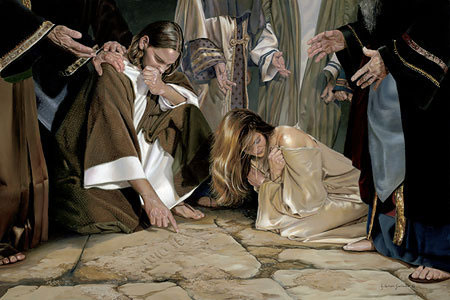
Honestly, I don't think it's ever our place to criticize other people at all; we have so many faults ourselves! However, if words of correction are to be given, (and there will be moments in our life where God will require us to do this), they must must MUST be done with charity as its main motivator. Charity suffereth long. Charity is kind. Charity is not easily provoked and rejoices in truth. That means our words should be full of patience, kindness, and love. Think in your head how Christ treated those around him. I can think of many cases where the Lord had to deal with people who made some pretty dumb mistakes. The story of the woman taken in adultery is a great example. Not only did Christ wait until he was speaking in private with the woman before he gave correction, but the words he said to her were direct, without guile. "Neither do I condemn thee; go, and sin no more." (John 8:11) I can imagine Christ's tone of voice as he says these words. Not icy and judgmental, but warm and inviting.

"Neither do I condemn thee; go, and sin no more."
Speaking out of pride, judgment, or selfishness is not acceptable before God. In Section 121 of the Doctrine and Covenants, the Lord counsels against any act of authority that is performed with ill motivations such as these. We read that "the heavens withdraw themselves [and] the Spirit of the Lord is grieved." (D&C 121:37) While this section particularly targets holders of the priesthood, Elder Holland says that "the sin of verbal abuse knows no gender." Anyone can be moved by pride to say something they oughtn't.

Unkind words may seem small, but they can lead to so much more. In the spirit of this same theory that I described in the beginning about how words can create, I believe that by saying something out loud, we are making it real to us. The more we say we believe something, the more inclined our brains are to believe it is true. That's why it's important that we not only have a testimony, but bear it in public. And that's why we are encouraged to pray out loud to our Heavenly Father from time to time. When we transform something as abstract and visceral as a thought into something physical like a spoken word, we are creating a reality in our minds that, with time, becomes part of our core beliefs, which are difficult to shake and result in action and behavior.

So words inspired by negative thoughts can then lead to negative attitudes and, in turn, negative behavior.

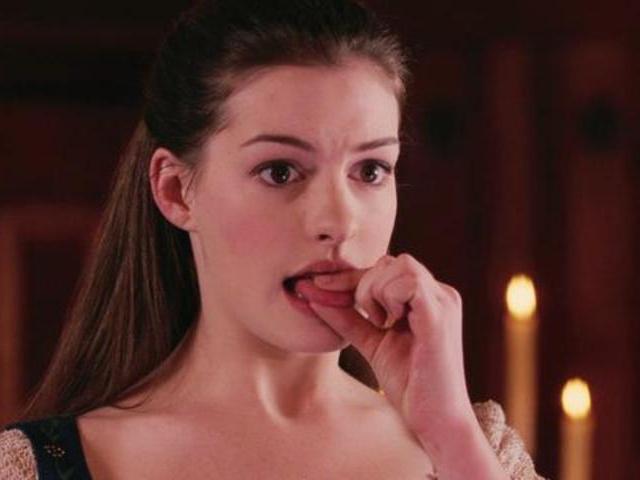
"Hold your tongue, Ella!"
We know that "by small and simple things are great things brought to pass." (Alma 37:6) But it's important to realize that those small and simple things can lead to either great miracles and blessings, or great disasters and failures. We see this all the time in modern society, and we also see it in the scriptures. When James refers to the tongue as the "very small helm" of the ship that is the body or a small kindling that can beget a forest fire (James 3:4-5), he is emphasizing how something very small can yield very large, often disastrous consequences. Most of the time an abusive spouse or parent begins with simple words before turning to physical assault. An unrighteous sexual act often begins with simply casual talk and joking about sex. I honestly don't think Laman and Lemuel would ever have tried to strike their brother Nephi or tie him to a boat if they had nipped their negativity in the bud and avoided all that murmuring. In contrast, look at the kinds of things Christ brought about by using kind, loving, clean words. We don't really know what happens to the woman taken in adultery after her exchange with the Savior, but I have a feeling that the way Christ spoke to her had a profound impact on her future behavior. A bridled tongue can lead to a more positive change in people than an unbridled one. It is through Christ's words, as well as his actions, that we saw miracles performed. As Joseph Smith says, "Faith...works by words, and with words, its mightiest works have been, and will be, performed."

Imagine what this knowledge of the power of small and simple words can do in our own lives! Not only will we bless the lives of others by using uplifting, positive language, but we will also change our own attitudes about life and about ourselves! How can a person who constantly accosts himself with negative language about himself feel good about himself? He can't! It's one thing to think poorly of oneself, but as I explained, it's even more hurtful to actually say things aloud because then it becomes real to us.

I have a good friend who is very successful and talented. Everything he touches seems to turn to gold. He's got a great job, lots of friends, and he seems to be good at everything! Piano, sports, video games, making friends, public speaking... He's like superman! One time I commented, "Geez, you have been blessed with so many great talents! I wish I was as awesome at all those things as you are, but I could NEVER be THAT good."

His reply was very passionate and from the heart: "Hannah, I think the only thing that separates you and me is the fact that I believe I can do something and you obviously don't. You wouldn't have said that if you did. You need to stop saying 'I can't' and start saying 'I can!'"
How does what we say about ourselves
indicate how we see ourselves?
I responded with a simple okay, but then he said, "And don't just think it. Say it. Say it now."

Elder Holland states: "In all of this, I suppose it goes without saying that negative speaking so often flows from negative thinking, including negative thinking about ourselves. We see our own faults, we speak—or at least think—critically of ourselves, and before long that is how we see everyone and everything. No sunshine, no roses, no promise of hope or happiness. Before long we and everybody around us are miserable."

Have you ever been tempted to say "Man, I suck at this"? I do it all the time! But the more I think about this friend's advice, the more I think that I need to change the way I talk about myself, even if it's just in jest. If we really understand who we are, and more importantly, who we can become, I don't think we would even submit ourselves to the kind of language that we so often treat ourselves to. Our words toward ourselves must be just as charitable, loving, and forgiving as they are towards others! Often there are things we say about ourselves that we would NEVER say about other people. I've called myself stupid, ugly, fat, incapable, worthless... Words I would never dream of directing towards someone else! How is it that we allow ourselves to be so negative towards ourselves, even though we claim to have a knowledge of our unlimited potential and divine nature!? It's almost like we think it applies to everyone BUT our own selves. That is a grave contradiction! Christ atoned for EVERYONE, including you, including me! God loves every one of God's children. And on the day of judgment, he won't stand for any unclean thought, word, or deed that has been committed towards any one of his precious sons and daughters of God (Alma 11:37). And furthermore, how can we expect to show love to other people when we don't show love towards ourselves? The words "Love thy neighbor as thyself" (Leviticus 19:18, emphasis added) come to mind here.

Christ atoned for EVERYONE.  Including you, including me!
I testify that the words we say -- as small as simple as they are -- can lead to great consequences. These consequences can be wonderful, but only if they are spoken with Christlike charity and love. I testify also that the words we say towards ourselves can have as equally profound of an impact on our lives as the words we say towards others. If we start using uplifting, pure language now, we will see positive results in our lives, and we will serve and uplift those around us. If our language is in line with the Lord's language, we will find our will aligning with His will. We will grow closer to him and closer to his blessings.